Saturday, June 21, 2025

From the Michael Gunderloy Archives: Spells, part 2 (1st Level)

     Between the table of contents and the spell descriptions themselves is a brief segment with rules on spell foci:

    "Every mage must have some item or object through which he focuses the power of his magic. Some ideas:
Staff or Wand
Crown
Sceptre
Packet of Herbs
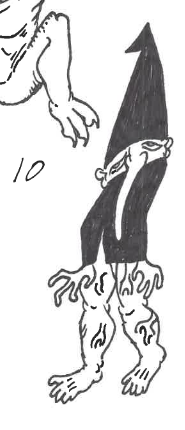
Pointy Hat
Robes
Ring
Amulet or Talisman
Spell Book
Any other object agreeable to the player and the GM.

    "In any case, the beginning mage must acquire or purchase his focal item before spellcasting. A beginner with one 1st level spell would then spend 1 day attuning his focal object to that spell: This is assumed to be done when a new expedition is outfitting.
    "If a mage loses or damages his focal object, he may not cast any more spells until he gets a new one! Once the new focal object is obtained, the mage must spend one day per level of spell with each of his spells, attuning the staff to the spells, before he may use them."

    This is quite flavorful, but I can see it also leaving the magic-user exceptionally vulnerable, since no special protective quality seems to be extended to the focus itself. A high-level mage who makes a daring escape from the jaws of death but fails to hang onto his hat would have to take many months off from adventuring or embark with an incomplete complement of spells.


    Spell descriptions themselves are given in two sections The first section is typed on blank paper (except for the 3rd-level spells, which are a longer but still incomplete list in the style of section two inserted at the appropriate point) and appears to consist largely or entirely of spells established from other sources, both the original OD&D books proper and the Arduin books. Towards the end of each spell level, handwriting inserts the names, but not descriptions, of the first few other spells appearing in the second section. Spells in section 1 are also numbered, except the third-level ones.

The first page of the typed spell description section

    The second section, on the other hand, is entirely hand-written on lined paper. Each spell level receives at least one page of its own in this section, though longer levels (4 and 6) receive two pages. Some, but not all, spells in both sections are marked with a P, X, or both in the margins. The meaning of these letters is not immediately apparent to me. What this suggests, to me, is that the first section may represent the "Initial" spell list used at the beginning of an established campaign, while the second is spells which were invented after the first document was typed up - either via magical research by players, or inserted into the world at the whim of the GM.

Spells of Level 1 are as follows - in places where a description has been redacted, the most legible or recent version is treated as canonical.

[Section 1]
1. Detect Magic: This spell determines if there is some enchantment laid on a person, place, or thing. It may only be cast on a single object at a time. If the item is magic, it will emit a soft blue glow. Range: 60'. Duration: 2 minutes. [P]
2. Hold Portal: A spell to hold shut a door, gate, lock etc. It will only work on non-living objects. A strong anti-magical creature will shatter a held door, and a "Knock" will open it. Duration: 2D6 2-minute turns. Range: 10'. [P]
3. Read Magic: This spell is necessary to read all scrolls written with Mages' spells. Without it, only the titles may be read. Range: 60'. Duration: 2 minutes. [P]
4. Read Languages: This spell makes any writing in any language legible to the mage casting it. Range: 60'. Duration: 10 minutes. [P]
5. Protection from Evil: This spell hedges the magic-user round with a magic shell six inches from his body. No enchanted monster may physically penetrate this shell. The mage also gains +1 saves and +1 Defense. This spell is not cumulative in effect with magic armor or rings. Range: Mage only. Duration: 1 hour. [P]
6. Light: A spell which lights a circle 30' in diameter. The light is not as bright as full daylight. Range: center up to 30' from Mage. Duration: 1 hour plus ten minutes times the level of the caster. [P X]
7. Sleep: Puts to sleep beings Σ HP ≤ Mage's level. Wake up if approached within 10'. Range = 240'.
8. Shield: By means of this spell the user imposes a moving magical barrier between himself and his enemies. It provides the equivalent of class 2 armor vs. missiles and class 4 armor vs. other attacks. Range: Adjacent to Mage. Duration: 30 minutes. [P]
9. Magic Missile: This is a conjured missile, fired with an accuracy of a composite bow +2, disregarding any dexterity bonuses. It does 1d6+1 points of damage, and there is no save if it hits. For every five levels above 1st which the mage has attained, he may fire an additional two missiles with every use of this spell. All of the missiles must be directed at the same target in the same melee round. Range: 150'.
10. Ventriloquism: The user may make his voice issue from whatever point within range is desired, without moving his lips. He may do this while he is carrying on another conversation, drinking water, etc. Range: 60'. Duration: 20 minutes. [P]
11. Darkness: A spell which causes total darkness in the area affected, making even infravision useless. It is otherwise the same as a "Light" spell. [P X]
12. Pyrotechnics: A multi-purpose spell which requires some form of fire to work. Does not work on living beings of any type. When employing this spell the Mage can create a great display of fiery, flashing lights and colors which resemble fireworks; or he can cause a great amount of smoke which will cover an area of not less than 20 cubic feet. The effects of this spell will depend on the source of the fire, and when the spell is over, the fire source is automatically extinguished. Duration: 20 minutes. Range: 240'.
13. Dispel Magic: The user may attempt to dispel the effects of any one encantation[sic] with this spell. The spell does not work on enchanted items of any type. The success of the spell is equal to the level of the caster of this spell over the level of the original spell caster. Range: 120'.
14. The Rosy Mist of Reason: A cloud of rose-colored mist which causes all intelligent beings within it to save vs. magic at -4 or be reasonable and discuss things instead of fighting. All unintelligent types have a 10% chance of leaving, a 20% chance of being indecisive, and a 70% chance of attacking. Range: 60'. Area affected: 60' diameter circle. Duration: 1 hour. [X] ([Margin note:] Semi: 70% discuss, 10% leave, 20% attack) [Editor's note: this spell is taken from Arduin 1, though with slightly different verbiage and the addition of the margin note.]

[Section 2]
Detect Shifting Walls & Rooms - Range = LOS Duration = 10 min. [P]
D. Sloping Passages, Stairs & Ramps - Range = 60'. Duration = 10 min. [P]
D. Secret Doors - Range = LOS Duration = 10 Min. [P]
D. Mechanical Traps - Range = 30' Duration = 10 min. [P]
Know North - Duration = 1 hour [P]
D. Food & Water - Range = LOS Duration = 10 min. [P]
D. Illusion - Range = LOS Duration = 10 min. [P]
D. Lycanthropy - One target. Range = 60'
D. Mutant - One target. Range = 60'.
Smokescreen - A screen of inky black smoke of the same dimensions as wall of thorns. 5% chance of blinding those who pass through for 1-20 minutes. Range = 120'. Duration = 10 minutes.
Create Frog - Creates a 1 HP, AC9 frog in the caster's hand. The frog lasts until killed.
Force Field - Caster only. Stops all natural attacks. Duration = 1 hour. [P]
Etherealness 0 - Caster only, puts caster on the Ethereal Plane. 10% chance/hour (noncumulative) of getting back.
Counting - Tells the mage the exact number of identical objects there are in a group of up to 100,000,000
Trapping Web - A gossamer webbing of fiberglass-appearing filaments, 10' D. It holds all of up to 6 H.D. Range = 30', Duration = 1 minute. [X]
D. Secret Panels - Detects secret panels, hollow compartments, and the like. Range = 60'. Duration = 10 min. [P]
Extinguish Small Fire - Gets one fire up to 10'x10'. Range = 120'.
Frost - A small (2' r) field doing 1DD of cold. No save. Range = 120'
Match - A small flame (1" long) on one's finger. Duration = as desired.
Wish - Infallible.
Heat - A small (2'r) field doing 1DD of fire damage. No save. Range = 120'
Cloak of Darkness - A form of invisibility vs infravision only. Not detected by see invisible etc. One target. Range = touch. Duration = 1 hour or until dispelled (dispels as invisibility).
Anti-Shadow - One target. Removes shadow completely. Range = touch. Duration = 1 day. [P]
Power Word - Zot! - Causes glowing purple letters saying "Zot!" 4' high to appear in the air and stay for 1 MR. May be cast in conjunction with any other spell. Range = 600'. [Editor's note: it has been proposed by various parties that this may be a reference to the newspaper comic strips B.C. and The Wizard of Id, the Adam West Batman television program's use of sound effects, or the 1947 novel Zotz or its 1962 motion picture adaptation, which concerns an individual with magical powers that are invoked via pointing and shouting the word 'Zotz'.]
Magic Trap - Enables a mage to store a L1-L3 spell in a container to hold his valuables. Both spells must be cast on the container. The MU must specify how to open the container safely.

Thursday, June 19, 2025

From the Michael Gunderloy Archives: Spells, Part 1

    The name Michael "Mike" Gunderloy is not wholly unknown to scholars of deep, weird nerd history, but discussions of him tend to focus upon his role in early fanzine culture or, on much rarer occasions, his authorship of various books on programming and web design. More obscure, and possibly unknown to the world at large, is his work in the late 1970s roleplaying sphere. His variant elemental magi classes were published in early issues of Chaosium's "Different Worlds" magazine in 1979. He was also a whole-hearted fan of Dave Hargrave's "Arduin" system/unofficial D&D supplement, and his essay "Arduin for the Masses" appears in the 5th issue (Oct/Nov 1979) of the same magazine. The third volume of "All the World's Monsters" also includes a few contributions by Gunderloy, among many others.

    Mike Gunderloy is my father. He has largely distanced himself from all these earlier portions of his life (not, I think, necessarily out of distaste, but merely disinterest) and is now quietly semi-retired in Oregon with his wife. When our family was living in Indiana, I inherited from him a large quantity of his old material relating to his games. The stack of aged papers is approximately a foot high. Some of it is redundant with other portions, but much of it is in very small handwriting, so attempting to look through this material is an enormously daunting task. Nonetheless, I have been told that transcribing some of this digitally may hold some small interest to certain portions of the general public.
The box in question.


    Towards the top of the stack is a document, the first page of which is headed "Known Spells". I can only hope that this means 'spells that are known to exist', since the idea of one magic-user knowing all these boggles the mind. Spell levels listed are between 1 and 14, with between 21 and 50 different spells listed for each level (though an additional sheet includes more spells of levels with too many entries to fit, bringing the maximum up to 56 separate 4th-level spells). Subsequent typed and handwritten pages include descriptions of what I hope is every listed spell, though even the table of contents is far more than enough to fill a post.
The index of Known Spells, level 1-8 (excluding select spells of 2-4th)

    Levels 1-8 take up the front side of one page, 9-14 much of the back, in tiny, cramped handwriting. Each of the first 8 levels are headed with a differently-colored circle of unclear meaning; higher levels have no such device.
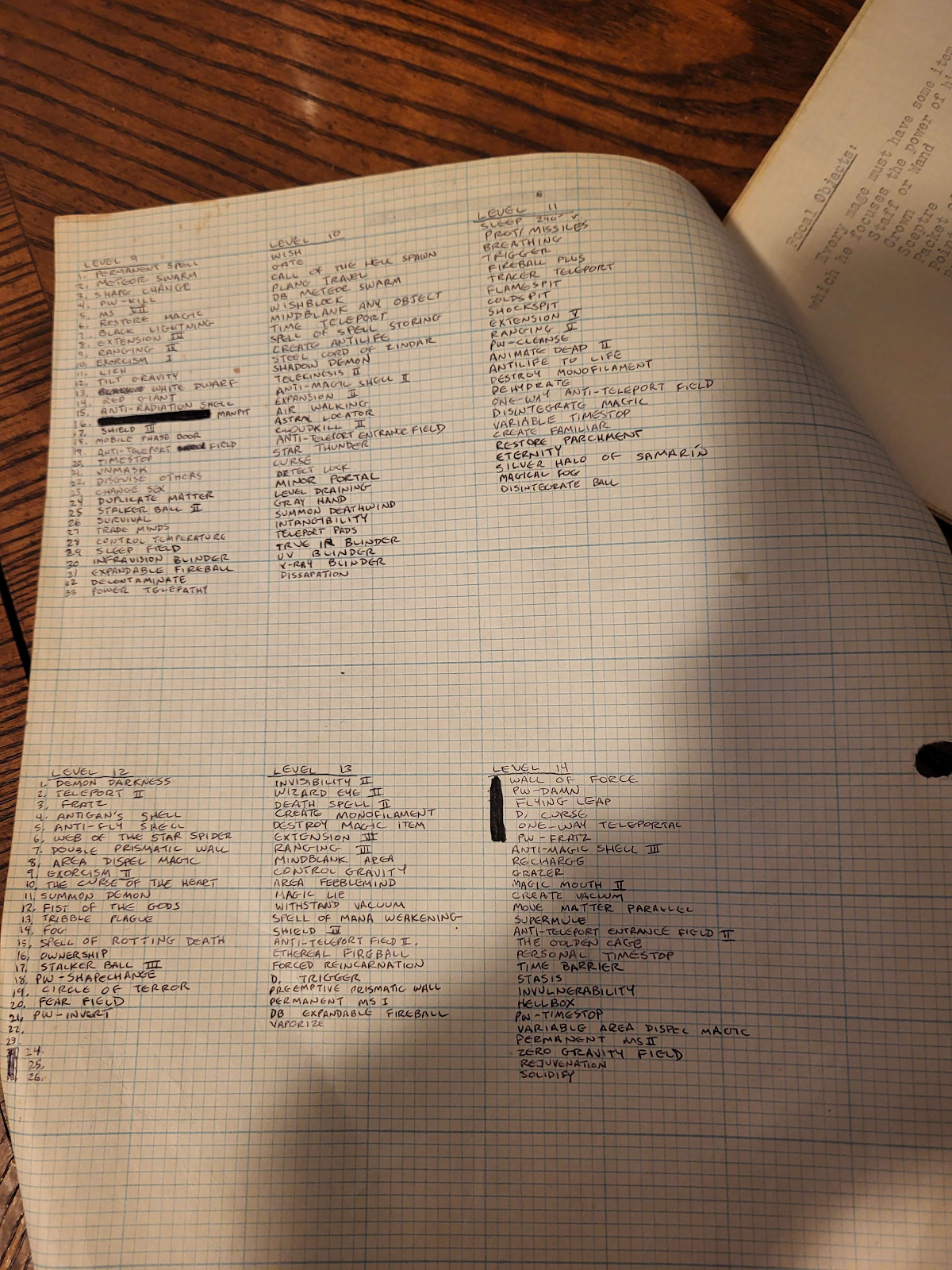
Ibid, levels 9-14

    Here follows the list of each spell:

Level 1 (Red-purple, 39 spells): Detect Magic; Hold Portal; Read Magic; Read Languages; Prot/Evil; Light; Sleep; Shield; Magic Missile; Ventriloquism; Darkness; Pyrotechnics; Dispel Magic; Rosy Mist of Reason; D. Shifting Walls & Rooms; D. Sloping Passages, Stairs, & Ramps; D. Secret Doors; D. Mechanical Traps; Know North; D. Food & Water; D. Illusion; D. Lycanthropy; D. Mutant; Smokescreen; Create Frog; Force Field; Etherealness 0; Counting; Trapping Web; D. Secret Panels; Extinguish Small Fire; Frost; Match; Wish; Heat; Cloak of Darkness; Anti-Shadow; PW-Zot; Magic Trap

Level 2 (Orange-red, 51 spells): Charm Person; D. Invisible; Levitate; Invisibility; Wizard Lock; D. Evil; ESP; Cont. Light; Knock; Strength; Glop; Magic Mouth; Clairaudience; Wall of Thorns; Anti-Web Aura; Telescope; Compare Lifeforce; Carry Voice; Colored Light; Snooze; D. Lies; Magic Hand; Fiery Flash; D. Harmful Radiation; Super Web; D. Traps; Charm Arachnid; Charm Crustacean; Charm Mammal; Charm Reptile; Charm Insect; Charm Amphibian; Amplify Sound; Disbelieve; Locate Any Object; Microscope; Muscle Spasm; Shield Killer; Supermatch; Bluff; Antibluff; Fire Flecks; Mold Cone; Dismal Itch; Visible Stalker; Line; Write Languages; Ice Slick; Awake; Auditory Illusion; Disorient

Level 3 (Pale blue, 55 spells): %ile D. Magic; Phantasmal Forces; Locate Object; Mirror Image; Fly; Hold Person; Clairvoyance; Fireball; Lightning Bolt; Cold one; Prot/Evil 10'r; Invisibility 10'r; Infravision; Prot/Normal Missiles; Water Breathing; Explosive Runes; Rope Trick; Suggestion; MS I; D. Life; Strengthen Armour; Idleness; Wailing Wheel of Fire; Wall of Fire; Wall of Ice; D. Change; See Invisible; Web of the Fire Spider; Spell of the North Wind Spider; Web of Paralysis; Ranging I; Mimic; Fire Resistance; Cold Resistance; Acid Resistance; Lightning Resistance; Poison Resistance; D. Metal & Type; Create Cat; Avoid Gaze; Messenger Bat; Bones to Jelly; D. & Remove Explosive Runes; Emphatic Self Cure; Explosive Rooms; Fenton's Silencer; Growth/Self; Message; Shrink Self; Speak Languages; Kamikaze Fireball; Unreadability; Feyor's Excellent Guardian; D. Ethereal Objects; Superchicken

Level 4 (Green, 56 spells): Slow; Poly Self; Remove Curse; Confusion; Charm Monster; Growth/Plants; Dimension Door; Wizard Eye; Massmorph; Ice Storm; Fear; MS II; Extension 1; Strengthen Weapon; Wall of Stone; Rock to Mud; Gaseous Form; Witch Fire Web; Tracker; Seal Portal; D. Undead; Weakness; Megaphone; Freedom; Body Heat; Decompression; Gold Cone; D. Demon; D. Curse; Create Dog; Black Bolts; Special Effects; Werelight; Float; Rot; Paralyze; Sonic Blast; Create Wind; Energy Ball; Gyration; Laser; Madness; Personal Wizard Lock; Poison Cloak; Shrink/Plants; Silver Stars; X-Ray Vision; Ball Lightning; Microscribe; True Infravision; Ultravision; Poison; Defense; Telepathy; Insensibility; Past Clairvoyance

Level 5 (Orange, 48 spells): Haste; Teleport; Hold Monster; Conjure Elemental; Telekinesis; Wall of Iron; Animate Dead; Contact Higher Plane; Pass-Wall; Cloudkill; Feeblemind; Growth/Animals; Stone-Flesh; Lower Water; MS III; Extension II; Pentacle; PW-Dispel; Masayuki's Mist; Rhyton's Release; Blinking; Ranging II; Regeneration; Selective Invisibility; Truth Call; Wings of the Wind; Expansion I; Withstand Cold; Withstand Heat; Shield II; Sewer; The Veil of Lan; Mind Mask; Reflect Gaze; Crystallize; Messenger Blip; Shatter Bones; Cast Illusions; Charge Wand; Escape; Reflect Laser to Source; Shrink/Animals; See Ethereal Objects; Sonic Ball; Sonic Bolt; Intangible Wall; Infrared Laser; Infravision Damper

Level 6 (Brown, 50 spells): Hallucinatory Terrain; Polymorph Others; Part Water; Projected Image; Anti-Magic Shell; Geas; Control Weather; Move Earth; Legend Lore; Repulsion; MS IV; Voodoo; Quicksand; Magic Jar; Red Death; Spell of the Spider Golem; Transform Others; Read Clerical Magic; Read Druidic Magic; Etherealness; PW-Believe; Man to Jello; Mind over Body; Summon Mount; Water Walking; The Deadly Bubbles Spell; Skywriting; The Pillar of Lenos; Detect Block; Create Tiger; Dispel Clerical Magic; Dispel Druidic Magic; Area Rot; Clumsy Field; Spell of True Seeing; Lead Spray; Rhoar-eee's Transit Spell; Charge Staff; Impact Resistance; Inversion; Prot/Death; Stalker Ball I; Censor Sphere; Blinder; Universal Detect; Personal Seal Portal; Sword of Paralysis; Transparency; Rock to Sludge; Lock

Level 7 (Darker blue, 38 spells): Reincarnation; Invisible Stalker; Death Spell; Disintegrate; DB Fireball; Reverse Gravity; PW-Stun; Phase Door; Charm Plants; Mass Invisibility; MS V; Extension III; Waragen's Wave; Falling for Forever; Star Bridge; Charm Demon; See & Handle Monofilament; Com-Link; Ranging III; Phase Etherealness; PW-Deafen; Spell of Burrowing; Prot/Energy Drain; Release Flame; Mule; Multi-Ball; Growth/Life; Black Mist; Spell of Scroll Protection; Mind Mask - Others; Locate Lair; Stayawake; Impact Resistance - Others; Charm of the Slow Hour; Excellent Green Spray; Maxivision; Ear Breaker; Shrink Life

Level 8 (White with black outline, 39 spells): Mass Charm; Clone; PW-Blind; Symbol; Mind Blank; Poly Any Object; MS VI; Immobilize; Maze; Prismatic Walls; Flames of Doom; Blaze of Glory; Create Trump; Shrinking Beauty; Shape Lock; Time Viewer; Regeneration II; PW-Gravity; Doppleganger [sic]; Spell of Guiding Blows; Growth/Minerals; Disintegrate Flesh; Disintegrate Steel; Suspend Animation; Vulnerability; Create Elephant; Control Water; Disguise Self; Infernal Barrier; Crack Walls; PW-Teleport; Doomkill; Forlorn Encystment; Inverse Clone; Devastate; Shrink Minerals; The Shrieking Cloud; Summon Ssherah; Clairvoyance of Owner

Level 9 (33 spells): Permanent Spell; Meteor Swarm; Shape Change; PW-Kill; MS VII; Restore Magic; Black Lightning; Extension IV; Ranging IV; Exorcism I; Lich; Tilt Gravity; White Dwarf; Red Giant; Anti-Radiation Shell; Manpit; Shield III; Mobile Phase Door; Anti-Teleport Field; Timestop; Unmask; Disguise Others; Change Sex; Duplicate Matter; Stalker Ball II; Survival; Trade Minds; Control Temperature; Sleep Field; Infravision Blinder; Expandable Fireball; Decontaminate; Power Telepathy

Level 10 (32 spells): Wish; Gate; Call of the Hell Spawn; Plane Travel; DB Meteor Swarm; Wishblock; Mindblank Any Object; Time Teleport; Spell of Spell Storing; Create Antilife; Steel Cord of Zindar; Shadow Demon; Telekinesis II; Anti-Magic Shell II; Expansion II; Air Walking; Astral Locator; Cloudkill II; Anti-Teleport Entrance Field; Star Thunder; Curse; Detect Lock; Minor Portal; Level Draining; Gray Hand; Summon Deathwind; Intangibility; Teleport Pads; True IR Blinder; UV Blinder; X-Ray Blinder; Dissapation [sic]

Level 11 (25 spells): Sleep 240'r; Prot/Missiles; Breathing; Trigger; Fireball Plus; Tracer Teleport; Flamespit; Coldspit; Shockspit; Extension V; Ranging V; PW-Cleanse; Animate Dead II; Antilife to Life; Destroy Monofilament; Dehydrate; One-Way Anti-Teleport Field; Disintegrate Magic; Variable Timestop; Create Familiar; Restore Parchment; Eternity; Silver Halo of Samarin; Magical Fog; Disintegrate Ball

Level 12 (21 spells): Demon Darkness; Teleport II; Fratz; Antigan's Shell; Anti-Fly Shell; Web of the Star Spider; Double Prismatic Wall; Area Dispel Magic; Exorcism II; The Curse of the Heart; Summon Demon; Fist of the Gods; Tribble Plague; Fog; Spell of Rotting Death; Ownership; Stalker Ball III; PW-Shapechange; Circle of Terror; Fear Field; PW-Invert

Level 13 (22 spells): Invisibility II; Wizard Eye II; Death Spell II; Create Monofilament; Destroy Magic Item; Extension VI; Ranging VI; Mindblank Area; Control Gravity; Area Feeblemind; Magic Lie; Withstand Vacuum; Spell of Mana Weakening; Shield IV; Anti-Teleport Field II; Ethereal Fireball; Forced Reincarnation; D. Trigger; Preemptive Prismatic Wall; Permanent MS I; DB Expandable Fireball; Vaporize

Level 14 (26 spells): Wall of Force; PW-Damn; Flying Leap; D. Curse; One-Way Teleportal; PW-Fratz; Anti-magic Shell III;  Recharge; Grazer; Magic Mouth II; Create Vacuum; Move Matter Parallel; Supermule; Anti-Teleport Entrance Field II; The Golden Cage; Personal Timestop; Time Barrier; Stasis; Invulnerability; Hellbox; PW-Timestop; Variable Area Dispel Magic; Permanent MS II; Zero Gravity Field; Rejuvenation; Solidify

Monday, January 6, 2025

On Sphinges

    Dragons typically claim themselves to be the eldest race of living creatures, but this is a reflection only of their narcissism. Each dragon believes that history and the world itself did not exist until they themselves were born - for how could a world without them possibly be real? A sphinx, on the other hand, knows with absolute certainty that they were the first.
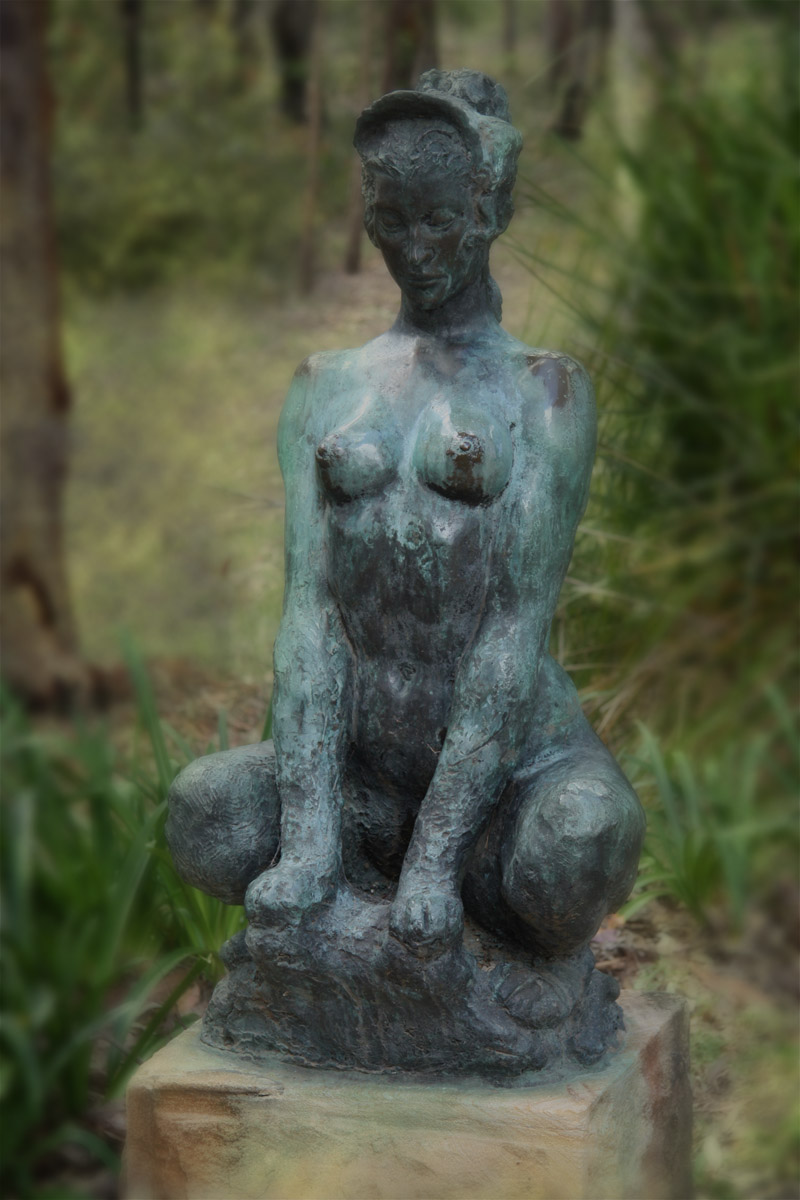
Statue by Norman Lindsay

    Sphinges are not omniscient, per se, but they know everything. They were the first beings created by the gods, and the sky god Summanus created their eyes from the essence of his indestructible body. Thus, they may see anything that occurs anywhere in the world, and they will never die of natural causes. They may be killed, but they will never decay - worms, moisture, and fungi will do nothing to them. Fire cannot burn them. If you wish to be rid of the corpse of a sphinx, then you must hack its corpse into little bitty pieces, every cut filled with intentionality.

    They have had since the dawn of time to learn, and so they have learned with certainty all physical laws that govern the world. A sphinx knows all the rules. They have, essentially, all the facts - if an event occurred more than 3 hours ago, a sphinx has already learned of it. They cannot read minds, however, and they cannot tell the future with certainty, for it has not occurred yet. They know enough about all men to know what is most in character for them to do, but they can still be surprised. If you have lived a virtuous and simple life, and in your secret heart of hearts have held a desire to catch a sphinx in a big net and flay it alive, then the sphinx would not know this - unless you have ever spoken it aloud, or acted sufficiently shady in preparing your big net.

    Cast a handful of sand into the wind, and a sphinx will be able to predict, with absolute certainty, where every grain lands, even with its eyes closed. They have what economists wish all mankind did - perfect access to perfect information.

    Perfect knowledge has made the sphinges grow bored and idle. Most of them have abdicated the earthly world and dwell now in the Plane of Clouds, partaking of the hospitality of the elemental lord Hirroo. They occupy themselves with contests of riddles between one another. A riddle, to a sphinx, is no mere tricky question, article of trivia or game of wordplay. Everyone knows the one about Man, and the one about A Coin, and the ones about A Coffin, Saint Elmo's Fire and Comte Escavoir de Sigons VIII. Occasionally, if a mortal is insistent, they may condescend to ask such questions, but the sphinx gains nothing from this - it's like when you ask a 4-year-old what color the sky is, and then congratulate them when they manage 'bwue!' on the third try.

    Riddles between sphinges are deep, elaborate labyrinths of many layers. Most people call them 'conspiracies'. Men and their kingdoms are a sphinx's playing pieces - sphinges do not crave power, and act with mere gentle nudges from a great distance, but they create great webs and mystery cults to draw in their ageless fellows. Their designs are so subtle and so far-reaching that they unfold across continents and over the course of decades or centuries - but they have all the time in the world to play. Typically, "Where is the sphinx's riddle" and "What question, exactly, is it asking me with this whole mess of secret societies" are deeply tricky questions that must be untangled and answered before one even starts on "What is the answer to the riddle".

    Adventurers might consult the boundless wisdom of a sphinx, if they had a means to find one. Sphinges are immortal, but they are not without wants and needs, and thusly they are not likely to give their vast knowledge away gratis. Genuine surprises are valuable to a sphinx, but they know you well enough to expect the first few things you would try to shock them after hearing that. They also value truly-kept secrets, personal perspectives or interpretations of riddles, and objects or information from the future. Sphinges are very good with concrete facts about the past or present - "How many jelly beans are in the jar?" "What were the last words of Ser Voldenay the Green?" "Where is the key to the imperial treasure vault right now?". However, they don't deal in prophecies ("How long will the dynasty of the Soolms endure?") or choices ("What is the easiest way for us to defeat the demon lord of the marsh?"), and they're not always confident even on seemingly naturalistic predictions like "When will the volcano erupt next?" - some wizard could always mess things up ahead of the geological schedule.

Wednesday, January 1, 2025

The Zungeon Table, as Endorsed by the Zungeon Master

 The Zungeon Jam is happening. It's a game jam where people make zungeons. I will probably be participating.

Step 1 is to come up with a theme for the dungeon, then mix it with 1 or more other themes. "But what," you (I) say, "if I'm creatively bankrupt?"
Roll on this table 1 or more times. Pick whatever result for a given line sounds best or most interesting to you, then combine with whatever other ones you pick from your other rolls. Alternatively, just roll once and read straight across, combining all 3. Or don't. Whatever.


I feel weird making a post without any images, and just a Discord screenshot feels lame. Here's a skeleton with some dice that I found on google images.

"Creature" is a type of living* being (Current inhabitants? Original inhabitants? Worshipped/Venerated? Appears in iconography?).
"Location" is a place (Original purpose? Current purpose? Nearby area of note? What the dungeon looks like it should be, but isn't?).
"Abstract" is generally, but not always, an 'element' of some vague sort (Suffuses the area? Wielded by inhabitants? Overriding decor theme? Part of a Special room or Puzzle the adventurers have to deal with?).

CREATURE/LOCATION/ABSTRACT

1: Mermaid/Waterfall/Slime
2: Vampire/Cenote/Lightning
3: Gargoyle/Clocktower/Shadow
4: Mimic/Organism/Sound
5: Daemon/Grove/Etiquette
6: Werebeast/Shipwreck/Alchemy
7: Giant/Crypt/Mirrors
8: Eye/Church/Gravity
9: Soldier/Natural Cavern/Time
10: Insect/Subway/Gold
11: Kirin/Quarry/Melting
12: Plant/Museum/Smoke
13: Sea Monster/Mine/Crime
14: Crone/Laboratory/Neon
15: Mummy/Spaceship/Fire
16: Psion/Menagerie/Food
17: Dragon/Haunted House/Rainbow
18: Leprechaun/Residence/Earthquake
19: Genie/Lost World/Glyphs
20: Adventurer/Bathhouse/Cursed

Don't like mummies? Choose wights instead. Leprechaun sounds too silly? Then make it a faun. Pick or roll or cut or paste or I don't know, I don't care, I'm not your dad. Like your dad, though, I do crave validation through engagement, so I would politely and humbly request that if you make use of this you tell me or mention it or leave a comment or something.

Nova (the mind behind the Zungeon format and the jam) had this to say:

Discord is refusing to show you, but I promise this was in response to me showing the table.

[UPDATE]:

thank you nova ;o;

[UPDATE II]:

This post has now been automated by Jonas-Merlin Schumacher. Literally minutes of virtual fun!

Friday, October 25, 2024

Vampire Weekend: "Playtime's over! Grant me power!"

    There's an event going on where a bunch of people post about vampires. You know who's a vampire?

This guy.

    Vampires as an institution have always tended slightly towards the goofy, but Castlevania's vampires (mostly just Dracula, but his underlings Olrox and Ca(r)milla and his predecessor Walter Bernhard have demonstrated similar abilities) are goofy in my favorite way: they suddenly turn into big silly-looking monsters for some reason.

The original 'transformed' Castlevania Dracula, and the sixteen-bit homage to it introduced in Rondo of Blood.

    The reasons why they can do this - or why they would choose to, other than to make the final battle seem more impressive (since most people seem to find the regular teleporting, fireball-throwing humanoid forms tougher) aren't ever explained in very much detail. It seems like Dracula himself may be more of a demonic possessee or antichrist than a vampire in the 'cursed undead' sense that we usually think of them - he was never actually bitten by anything, instead getting his powers originally from having a magic stone that captured the soul of another powerful transforming vampire, and also made the Grim Reaper his best pal. 

Look at this fucking thing. This is a vampire.

    In the Japanese manual to one of the NES games, it's proposed that Dracula struck a bargain with a forgotten evil god to resurrect its cult; when he reincarnates in the mid-2010s as a Japanese amnesiac, it's suggested that the cosmic force of Chaos has selected him to be a figure in direct and eternal opposition to god. It's never explained why this necessitates turning into a big freaky muppet-ghoul, though, or why other vampires can casually do it (presumably without being the earthly avatars of their own anti-deities), or why he has so many different 'true' forms.
(Although, interestingly, there IS a canonical explanation for why his pre-transformation human forms look different - Dracula 'resurrects' by incarnating his disembodied spirit into a suitable corpse, so it's literally physically not the same guy every time!)

    Still, it's a really iconic and fun ability, and one that I think there's potential to use in RPGs. If Bram Stoker and Tracy Hickman can invent their own vampire powers for us to iterate upon and exploit, why can't Hitoshi Akamatsu? With Wizards of the Coast's push towards cinematic spectacle and climactic adventure bosses, it's shocking that Strahd von Zarovich hasn't turned into some kind of giant skeleton-snake-mosquito or discount Satan. 
Things get especially hogwild on the Nintendo 64, where this lumbering thingamajig transports your hero from the foggy spires of his castle to some kind of wastelandish pocket dimension with a stormy yellow sky.

    It's not as if you're lacking for options mechanically to represent whatever doofus your vampiric villain turns into - if your party is formidable enough to stand up to a bear (and they probably should be, if this is the kind of confrontation they're getting into), the most common bulky-bat-men Draculas bear a striking resemblance to the Type IV Demon or Nalfeshnee, and a one-off form that your villainous vampire turns into is the perfect opportunity to test out that esoteric random generator or gimmicky stat block from your favorite monster book that you're not sure you want to canonize as a whole species in your world. I also can't help but think of Nick Whelan's encounter tables, and the idea that "2 is always a dragon, 12 is always a wizard" - a single NPC who can turn into, effectively, both, gives a way to construct such a table without overcrowding the dungeon environment with independent populations.
Naturally the g-g-g-g-giiiiirl vampire gets a bit hornier of a transformation than Drac himself, but it's still an amusingly inexplicable combat form, and I think that tangled spine-hair is a fun image.

    As for precisely why this happens, well..

    With my own weirdo lore about the Negative Energy Plane as a place of void, darkness, and unactuated potential, what if Vampires as Undead beings are less 'corpses' and more 'animated ideas'? If - as a certain frothing racist wrote - the oldest and most powerful emotion of all sapient beings is fear, then a vampire might be a bodiless consciousness from the Negative Plane, parasitically attaching itself to a creature's fear of ambiguous spookums that live in the dark to take on semi-corporeal form. Feeding on blood without completely killing and exsanguinating could be a way to maintain or strengthen this connection - a vampire's immortal brides could be captives it perpetually feeds upon every so often, not because it has any actual dietary or caloric requirements but to keep them in a state of awe and fear at the terrible hungers of the vampyr.

    Direct confrontation, then - or unshakable religious conviction, or the pure clear light of the sun - could force a vampire to stop being nebulous and take on a definitive form - still fearsome, yes, but ultimately knowable and slayable. Perhaps the misty form taken on HP depletion of the classic RPG vampire is even an instance of this - a vampire whose power was so lacking that it could not 'resolve' into anything, and dissipated into bodilessness, to either return to darkness where something else horrible might lurk or be banished forever back into the realm of potentia.


Monday, September 23, 2024

20 Dusts

Pigments for sale in Goa, India. Photo by Dan Brady, Wikimedia Commons.

1: Dust of Disappearance. The all-time family favorite for decades! Renders objects or creatures temporarily transparent to visual rays, causing them to be invisible.
2: Dust of Dispersal. Though physically lightweight, this magical dust is so dense as to distort the local fabric of space. Causes targets to teleport short distances in random directions.
3: Dust of Discussion. A soothing perfumed incense with a calming, soporific effect. While it burns, encounters have a greater chance to react favorably.
4: Dust of Disturbance. A potent hallucinogenic drug derived from crematory ashes. Induces terrifying visions, duplicating a Cause Fear spell.
5: Dust of Dismemberment. A metallic powder composed of countless tiny razor-sharp blades. Must be handled with a metal gauntlet or thick leather glove, as it wounds any exposed flesh.
6: Dust of Disgust. A horrible nerve agent absorbed through the skin. Causes itching, nausea, chills, loss of constitution, vomiting, and all manner of horrible physical symptoms.
7: Dust of Discovery. Each individual granule is painstakingly coated in gunmetal-blue wizardly ink. When cast at an invisible entity, the inky particles cling to it, allowing its silhouette to be seen.
8: Dust of Disrepair. The dormant sporelings of ravenous magical fungi, similar to yeast. They cannot feed on living matter, but will eat through any dead organic material - they can destroy a wooden door entirely (except its metal locks, hinges, &c.) in a single turn.
9: Dust of Disaster. Made from the crushed wings of that most dire of omens - the butterfly. In 1d100 months, a terrible natural catastrophe (hurricane, earthquake, vampire, thaumatomic bomb, &c.) will befall the location where it was sprinkled.
10: Dust of Disarray. The shed skin cells of brownies, domovoi, and other household spirits. Sprinkling over an organized assortment of items will cause them to immediately become jumbled at random.
11: Dust of Disconnection. Tiny, specialized spatial portals permeable only to living creatures. Sprinkling or rubbing on a joint allows a portion of the body (finger, arm, leg, head, and so forth) to 'detach' from the rest and move independently, an effect that is profoundly upsetting to the recipient.
12: Dust of Discordance. This is not a pitch-black, deathly cold dust left behind by concepts annihilated from reality. It is, however, a powder of crystalized fragments of pure sound, creating a terrible clamor whenever it lands against a surface other than its magical velvet carrying pouch.
13: Dust of Disembodiment. Shavings of skymetal from the astral plane, imported at considerable risk and expense (or so the merchants who command extravagant prices for it claim). Snort it, and you can project your consciousness into higher spheres - your body remains in the material world, however.
14: Dust of Disencumbrance. A substance so light, it actually has negative weight! Carrying a pouch will reduce the weight (but NOT the volume!) of your carried equipment.
15: Dust of Disintegration. Beware this agglomeration of miniature spheres of annihilation! Though the scale of the destruction they can inflict at a touch is smaller, it is just as utter and just as painful.
16: Dust of Disinfection. A society of generally cooperative Poindrones, the least of Modrons. If quickly applied to an envenomed or diseased creature, they can scrub the system utterly of toxins, curing the symptoms and leaving the area cold and unnaturally pale for several weeks.
17: Dust of Disorientation. A parasitic colonial organism that takes root in the inner ear. If blown or thrown at an opponent's face, it will burrow into them, disrupting their sense of balance and severely limiting their motor control.
18: Dust of Distillation. A fine sediment originally discovered in the vats of Siegmund, the first alchemist. When mixed with a potion, the liquid component is evaporated, leaving a solid residue with doubly potent effects. However, the process of properly ingesting this residue (by carefully applying to the gums and nasal membranes) takes a full turn.
19: Dust of Diseasedness. A culture of horrific deeply infectious hell-bacteria, causing a nightmarish contagious illness that causes the living skin to fall off like flaking dandruff. The bacteria and the contaminated victim's remains both linger in the air - unless a gas mask and full protective clothing is worn, it is quite likely to backfire on the user and any allies.
20: Dust of Disappointment. It's... just dust.

Saturday, September 14, 2024

The Seas of Heaven and the Moons of Hell

    Heaven has seas deeper and stranger than the world of men. Just as the land issued forth from the primal unformed waters, so did the pillared halls and wide promenades of Heaven rise from depths you could scarce fathom. Where the earthly sea grows dark, Heaven's grows ever brighter: you can see as clear as day whenever you are below, and as you dive deeper it grows so intense that you must wrap your head in layers of sackcloth to avoid going blind. At the very floor, the boundary between light and water blurs, dissolves - both are one, a sea of liquid brightness surrounding you as beings of graces far stranger than the ones on land swim and scuttle and writhe. The deepest of trenches lead directly into the Positive Energy Plane, the realm of pure Phlogiston, the axiomatic and undeniable substance. It is impossible to return from these deep vents if you enter - to perceive Phlogiston's burning beauty is to be filled with the blessed and pure truth of it, and both your mind and body will turn to more of the perfect and colorless solid light.

Tranquil statues, not shaped by any human hand but merely present, are recognizable features of the shallows. Also commonly encountered is the bishop-fish.

Angelic fauna of the bright abyss (1d8):
1: Towering faceless humanoid formed of pure ivory. Ponderous footfalls. Occasionally digs into the glittering sand as if searching for something buried.
2: 50-foot feathered eel, with a serene death mask for a head. Pulsating veins of bright colors shift beneath its plumage.
3: Immaculately formed septopus, each arm bearing a tablet with the name of a forgotten god. Each can be used as a scroll of a 5th-level clerical spell, but mortal men turn to clay after 1 such use.
4: Five-mouthed colorless flame, razor teeth dribbling gold venom. Save vs. poison or be purified of sins you have no word for.
5: Man-sized barnacle in a shell of marble, filigreed in gold. Its cirri could be used as bladed whips. May portend a phlogiston vent.
6: Scuttling silver crustacean, four eyes alive with terrible energies. Speak a command in an ancient tongue, and it will unerringly seek out 1 living creature anywhere in creation.
7: Predatory fish, stained-glass skin pulled taut over intricate metallic skeleton. The beautiful scenes it depicts do not ease the pain of the deep lacerations it can inflict.
8: Gelatinous colonial organism of morally pure subsapient souls. Though its form is malleable and of many bodies, most often it is shaped like a gentle hand.

    Hell is the place where Negative Energy moves from potentia into definite physical form. The boundless black sky of the void is a place of pure might-and-could-be - anything COULD lurk in the darkness - but to become real, it must shed some of its purity and take on a true and knowable shape. This process is strange and often upsetting to the minds that descend from the Negative Energy Plane to become demons - if their efforts are not rudimentary and feeble, they are liable to be hideously distorted, loathsome both to look upon and to occupy. It is said that the great lights of the countless moons in Hell's eternal night are the eldest to have passed into Being, and they swirl and jockey for position in the firmament in an elaborate and endless dance of celestial politics.

The names of countless moons are recorded in Hell's chronicles - Allabar, Remina, Atropus - but some are known by many courtesy names, and some are long-dead or yet to be born.

Which Moon shines brightest in this part of Hell? 1d8:
1: Nicator, coldest and most covetous. Spilt blood freezes into blades.
2: Urb'luu, whose solemn green light shrivels tongues. No words may be spoken under it.
3: Murmur, the forgiving and timeless. Whenever a roll is made, roll twice and use either result.
4: Gurthang, darker than the night sky around it. None who die beneath it can ever return by any means.
5: Zkauba, clamorous self-devouring catastrophe. Any damage prompts a morale check as the wound erupts into writhing gore-tendrils.
6: G'broagfran, patron of poisoners, arsonists, and weavers. In your dreams, you see a masked and bound figure. You may ask one question of them - their answer will be a lie.
7: Quine, who calls thousands of thousands of beetles to coat all available surfaces. They bite at exposed skin.
8: Sárku, thrice-shattered mirror. Its sickly purple glow turns organic forms into rigid angles.


Tuesday, July 16, 2024

La-Mulana, Tomb of the Serpent Kings, and Multi-Layered Tutorials

    I'm one of those people who never shuts up about one specific video game, specifically GR3 Project's 2006 freeware metroidvania La-Mulana. This is surely due, in large part, to having seen Deceasedcrab's let's play of the game as a tiny, dumb child, and it thereby being my first exposure to those genres (both of video game and of video). Yet besides my own personal nostalgia, I maintain that the game is an extremely clever, atmospheric, and well-made example of its genre, and is one of the standouts of the early-mid 2000s indie scene. My feelings on the 2012 commercial remake are significantly more negative, for various reasons - some relevant to this piece, some not. The important part is, I regularly play through the game (as I would recommend you go do when you get a chance - it's on archive.org, though you might need to do a little bit of troubleshooting running it on modern computers due to its age).

It's a good game, yall.

    It was on one of these playthroughs recently where, during the early areas I had long since mastered and memorized, I found my mind wandering to how they served as implicit introductions for concepts that would inform the rest of the game, without ever actually becoming a formal player-facing tutorial. It occurred to me, then, that this was the same thing the famous Tomb of the Serpent Kings does (or attempts to do) for tabletop roleplaying. And, much like La-Mulana, Tomb of the Serpent Kings has structural divisions within its text and paratext that form layers of instruction for play that build on each other.

    So, y'know, since I've had a mildly original thought (a rare occasion), might as well write it down and see if anyone gets anything out of it.

The First Layer: the Enclosed Instruction Book

    The most important thing I, or any other person recommending the original La-Mulana, would tell prospective players is to read the included manual. Not only does it provide the controls and some explanation of systems that might be mildly confusing - the basic mechanical levels on which you interact with the game - but it's also just a neat little feelie that plays into the game's two intertwined theses (the feeling of archaeological investigation, and the experience of gaming on the MSX computer system). There's even (minor spoiler) an important puzzle solution included somewhere in there, and other information you'll want to know or be able to reference.
And it comes with illustrations and lore and shit! It's charming!

    The parallel is fairly obvious - the RPG equivalent to the manual is the actual rulebook of the game or system you'll be playing. Like the manual, it is not in and of itself the game - it doesn't contain the experience of play - but it introduces you to the game and the ways in which you'll play it, gives you a feeling of the game's atmosphere and tone, and encourages you to adopt mindsets that will be productive in approaching the game. And, much like the manual itself, you don't have to read straight through the whole rulebook of the TTRPG you're using (which can be a daunting prospect depending on the game!), but you can find the most relevant portions to understand what you'll be doing and how the procedures of mechanical play will work, the ways you'll be interacting with the game, and you can and probably should keep it on hand as a reference.

The Second Layer: the 'Safe' Outer Area

    When you start a new La-Mulana save file, immediately after a very brief introduction (literally 2 sentences), you're dumped right into the game's first area, the exterior of the ruins, the only direction or task you're given being that which you have from the manual (and your basic familiarity with, you know, the idea of a video game). You're here to find a marvelous treasure of some sort, but where and how you do that is up to you to figure out. So, you (most likely) start by checking out the door right next to you, receive very vague and cynical advice ('You can go into the ruins, if you'd like. You'll probably die like everyone else who's tried. Not that I care'), and are left to fend for yourself.
Also, like, tangent, but the surface is just such a good example of how good the game is at establishing a mood with its seemingly simple graphics and its music. The darkness of the surrounding forest and cliffsides, with just a little bit of sky peeking through at the top, makes the village feel isolated and vaguely portentous, but the chipper and upbeat 'Mr. Explorer' gives a feeling of optimism and enthusiasm for adventure, its grandiose melodies hinting at the hopes of finding something incredible.

    The surface - or its equivalent in Tomb of the Serpent Kings, the False Tomb - is a chance to apply and experiment with the things you learned from the manual. It's a simple area that gives you a few hints, a few goals to keep in mind as you move forward (gotta save up money to buy that software!), wide open spaces to move and jump in as you get used to the physics, and fairly simple enemies to kill and examples of the game's primary recurring simple elements (breakable pots with loot, signs to read, pedestals to activate mechanisms) to ease you into the act of playing the game. At the same time, it's not something you can completely and effortlessly clear out - there's danger, things you'll need to come back later to deal with, things (fairly clearly signposted) that will kill you quickly, a treasure chest you'll need to figure out how to open on your own. The set of interactions it gives you with the game world are limited, but it still expects you to take that world seriously, and teaches you that if you don't - if you try to fight the giant blue invincible guy with your leather whip, or jump unprepared into the rapids of the waterfall, or just bump into too many enemies without saving - you'll face genuine consequences, up to and including death.

The Third Layer: You'd Better Learn

    If you live long enough to solve the simple not-really-puzzle at the entrance on the surface, then you're rewarded with passage into the thing the game is actually named after - the ruins of La-Mulana themself. This is where the game starts being serious, showing you the formula major areas throughout the game are going to have - solve puzzles, decode clues, eventually get the pieces you need to fight a boss - then beat it, hopefully. Also, much like Tomb of the Serpent Kings, La-Mulana seems almost to be going out of its way to teach you a specific lesson in each room.
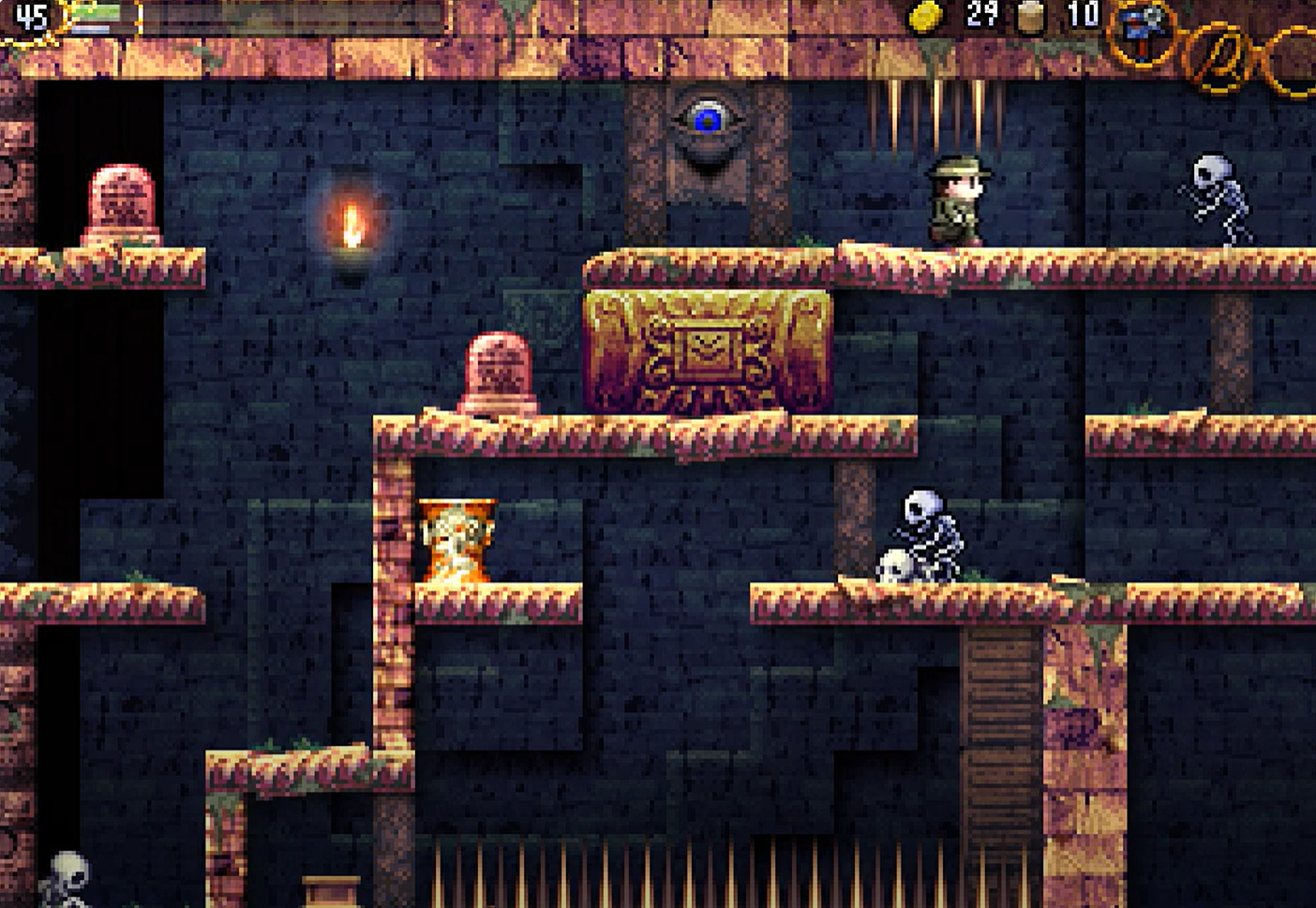
The lesson of this room is "Don't fall for obvious traps"!

    In fact - and this might be a contrarian viewpoint - La-Mulana might do better on its room-by-room teaching style than TotSK. While it's discussed as a goal in the introduction, and maintained to a degree throughout, a lot of rooms don't actually have much of a lesson to them, or are lessons only specific to the dungeon itself (or even just a limited part of it), like the 'statues hide secrets' idea. In contrast, the things you learn in the Guidance Gate are going to be ideas you build upon throughout the course of the whole game. Still, the approach they have to these lessons is generally the same: you're never actually outright told anything, as a player. Instead, you learn the lessons from this area organically, in the course of play and doing the interactions with the world that seem either obvious or implied. You feel clever for figuring things out, even though the environment is designed to make you figure those things out.

Over-Tutorializing - Get Me Off Your Fucking Mailing List

    I do not care for the remake of La-Mulana. I am very vocal about this. I am also, generally, alone in holding this opinion - the remake is far and away more popular, was the only version to get a sequel, and is usually considered a major improvement over the original. Certainly it's indisputable that on a technical level, the graphics and music are more detailed and impressive (though I have plenty to rant about on how the new graphics actually undermine the themes and atmosphere of the game). But what feels a lot less like an unqualified improvement is the changes to the way the game teaches you things early on.
Screenshot taken from raocow's playthrough, because like hell am I gonna download this version again.

    In the remake, Elder Xelpud (fun fact: "La-Mulana", "Xelpud", and "Lemeza" (the main character's name) are all Japanese-language reversals/rearrangements of the developers' usernames - "Naramura", "Duplex" and "Samieru"), the character who told you to go off and die, takes a much more... active role, in the gameplay. He'll be sending you in-game emails throughout the course of play, and these things are - more or less - direct hints or instructions on how things in-game work. Now, figuring out how things work isn't a matter of going "Hm, the signs outside and the notes on these explorer skeletons are readable, but the stone tablets inside just display this weird cuneiform - I wonder if that's related to the Glyph Reader rom for sale in the village?", it's a matter of Xelpud emailing you the moment you see or interact with your first tablet and directly telling you "Hey, you need a Glyph Reader to read these."
    
    This sounds like a minor quibble - and to a degree, it is - but it happens with everything early in the remake. Find a differently-shaped stone tablet and wonder what's up with it? You get an email saying "Hey, you can teleport to those with the Holy Grail." Solve a puzzle and pick up some shurikens? You get an email saying "You can find sub-weapons in the ruins, you use them with the sub-weapon button, they consume ammo that you can buy or find in pots." Fall into water and start losing HP? "Water hurts, you'll need to find an item to enter it without damage." You're not being trusted to figure out or intuit anything on your own, even the most basic things - so when the point comes that you're expected to do actual complex puzzles, rather than being confident in your ability to interpret or synthesize information yourself, you've been put in a mindset of expecting Xelpud to do it for you. You can, to be fair, unequip the email software if you really want - but how many players are going to think to do that on their first playthrough? Particularly when they can see there's an achievement for getting all of them? Oh - and progression is tied to reacting to these emails at one point (Xelpud gives you a clue that you won't get anywhere else), so you can't actually really do that anyway. The game, through this feature, is training you to be worse at playing it.
Ibid.
    Other features in the remake teach you lessons that are deleterious to your experience, too. Whipping certain things in the ruins will cause you to get struck by lightning. It's painful, and sudden, and it can feel unfair at first, but after a while you start to get a handle on the rules behind it - essentially, things that trigger a lightning bolt are always going to be either 'sacred' objects of particular religious importance or major recurring features you need to deal with in other ways (aside from one really weird wall in the Mausoleum of the Giants that, as far as I know, is unrelated to anything). But evidently this was considered too harsh for Wiiware gamers, or beyond their capabilities - so the remake adds the Eye of Divine Retribution. See that blue eyeball up there? Now, in every single room of the game where attacking something can get you struck by lightning, that eye is there as a 'hint'... except the eye remains even if whatever can trigger the lightning disappears (which is a frequent occurrence!). Now, instead of the player learning a first-hand lesson to treat big holy relics with respect, the eye is teaching players to be cowardly, promising danger even when a player who had learned to develop their intuition in the original would realize there's none there. One of the very few improvements the sequel to the remake made (alongside making lots of things even worse) was make the eyes close once nothing in the room can trigger them.

    There's one last thing for me to gripe about, and it feels really inexplicable. The original La-Mulana was a game that expected you to take notes, or else have a really prodigious and specific memory. There are specific numbers, rituals, orders, locations - all kinds of things - that you, the player, need to write down or remember. You can always go back to reread a clue - if you can find where it is. It demands a careful and detailed approach. The remake teaches you this skill doesn't matter, while at the same time demanding it more from you. Another piece of in-game software you can find lets you record the text (and diagrams) of any readable object or NPC dialogue, and reference it later indefinitely. The obvious message from this being a feature is "you don't need to make your own notes, this item will take care of that." Yet one of the few new puzzle elements the remake of this puzzle game introduces is one that demands note-taking - certain clue tablets are indecipherable, even with the Glyph Reader, until you've found an arbitrary number of rosettas stone in other later areas and backtracked to them. But because note-taking up until this point has become a process of just 'press button for screenshot', a new player isn't in a mindset to take their own notes on where they'll need to return to - so the point where you need the clues from these indecipherable tablets becomes an exercise in frustrated wandering through areas you've already explored.

    What points or insights do I have here?
    None. Goodbye! Play La-Mulana.

Wednesday, July 3, 2024

The Monster (Pod) Manual

 (Being an entry for DIY & Dragons' Summer Lego RPG Setting Jam)

Heroica, the Lego group's short-lived vaguely RPG-inspired board game subtheme, is fondly remembered by many fans, and revivals/remakes to the line are regular fixtures on Lego Ideas. Less well-known, or at least less-discussed, is Lego's brief foray in the early 2000s into the world of the miniatures skirmish wargame.


"X-Pods" were a kind of thematic precursor to the 3-in-1 Creator sets that grew more common in later years. Each was a collection of various assorted parts in a common color scheme, and came with instructions for 3 different builds in the same 'genre'. The Wild Pod (above), for instance, featured building instructions for a dragonfly, a bird, and...
Yeah, I don't know, either.

Besides the main builds included in the physical instruction booklets, however, Lego's website also had rules and factions for a board game called "X-Pod Playoff", where two players built little units out of a handful of pieces and maneuvered them on a printed grid. These have since been deleted from the official site, of course, but Joe Wreschnig has preserved PDFs of all the boards, starter sets, and expanded unit lists. In particular, the purple-green-white "Monster Pod" (official set #4338) has 20 little weirdos who I thought could use some lore. Much (almost all) of this text previously appeared on my tumblr, but they're now presented here with original illustrations by my exceptionally talented wife, minimal stats, and brief mechanical descriptions of any unusual abilities.

d20:
1: Big Mouth
2: Bucky
3: Creepie Crawly
4: Dizzy
5: Eyeball
6: Eye Beamer
7: Eyestalk
8: Frightful
9: Gremlin
10: Gremlin Hotfoot
11: Gremlin Porter
12: Gremlin King
13: Hoppy
14: Hypno Thing
15: It
16: Jumpy
17: Monster Surgeon
18: Nurse Scarem
19: Slither
20: Smiler

Big Mouth: A primitive subterranean relative of the ogre, the Big Mouth resembles a gorilla or other large ape, but its hindlegs are reptilian and it has a stubby serpentine tail. The pronounced fangs of its lower jaw inject a numbing venom, allowing it to devour helpless prey at its leisure.
D10A0, bite attack prompts save vs. paralysis as ghoul.

Bucky: A manic demihuman with elongated teeth honed to a razor-sharp edge. These teeth are used both to scrape the bark from colossal underworld fungi and to defend themselves from predators, compensating for their lack of arms. They sprint through darkness with astonishing speed, serving as couriers for an unknown intellect.
D4A1, triple normal speed. Wounds and damage do not appear until 1d4 turns after initial attack (see 'Kamaitachi' in The Monster Overhaul). 

Creepie Crawly: Largely harmless vermin that live in magical caverns. More the 'idea' of an insect than an actual insect - they are chitinous facsimiles composed of all the parts humans fear most, and their insides are almost wholly raw magic.
Noncombatant. Presence may inflict minor penalties on arthrophobes.

Dizzy: An eerie horned creature most easily recognizable by its total lack of limbs. It revolves around the donjon on its dish-shaped underside, drawing slow lazy loops. The sight is strangely fascinating, and the magic contained in its beady black eyes enhances the effect - weak-willed targets abandon combat to stare in perplexed fascination at the Dizzy's spinning.
D6A1. If visible, save or become fixated. Eyes may be averted, as with basilisks &c.

Eyeball: A luminous fungal creature originally adapted to the caverns used to house the Tarrasque, the King Caesar, and other massive beasts; it is adapted to mimic these creatures' eyes staring from the dark, hoping to make the simple-minded flee in the belief that they have encountered a more dangerous being. Often found in mated pairs.
Noncombatant, or D2A0. Portends potential danger nearby...

Eye Beamer: A relative of the infamous beholder, crossbred with a humanoid through means that are best left unconsidered. It has lost the flight and versatility of its evolutionary ancestor, but reproduces faster, and its single beam is projected continuously as long as its eye is open.
D8A2. Choose or roll 1 eye beam from standard Beholder list - directable at 1 creature/round.

Eyestalk: A single hooved leg terminating in an unblinking green eye, hopping aimlessly through the underworld. Poetically termed "Little One Eye" by Dverger, for whom they are a staple food source.
D6A0. Animalistic intellect.

Frightful: When immobile, this magical construct is indistinguishable from an eerie and elongated wooden mask. They are created by magic-users as spies and guardians - their gaze is telepathically linked to the wizard's mind.
D4A2. Low morale. Camouflage, psionic link to master.

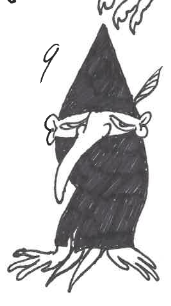
Gremlin: Like a goblin, but more outright wicked than pathetic. Consider themselves the intelligentsia of the dungeon, and refuse to hear any evidence to the contrary. Distinguished by their signature pointed caps, the making of which is a closely guarded secret.
D4A1. Other variants appear in sufficiently large groups, according to number, like most demihumans.

Gremlin Hotfoot: Gremlins are exceptionally sensitive to ley shifts, causing them to frequently mutate. The Hotfoot is a gremlin with elongated, muscular legs, and they are considered the warrior caste among their kind, for however little that means.
D8A1, double normal speed, double normal pride.

Gremlin Porter: A gremlin whose arms, rather than legs, have mutated to become astonishingly muscular. However, a curious anomaly in their brains makes them timid and nearly incapable of violence, so their fellow gremlins mostly use them as beasts of burden rather than the brutal fighters their appearance might suggest.
D8A2, carrying capacity as stone giant. Will not intentionally attack, but can be tricked.
Gremlin King: An especially rare variety of gremlin, the King towers over its lesser kin at nearly 4 and a half feet, and is by far the wisest of the species. Their arms and legs are both well-developed, though not to the extent of the lesser castes, and they typically fight with twin daggers.
D10A1, attacks two targets/round. In their presence, lesser gremlins will not flee, but may simper.

Hoppy: A mollusc adapted to live in pit traps and chasms, they leap with truly astonishing force from the depths of their homes to surprise adventurers passing nearby, hoping to startle them into falling, at which point they are fed on by the Hoppy. Known for its headcrest - actually a tendril of exposed nerves - and for its cry of "BOOGA-BOOGA-BOOGA!"
D6A1. Jumpscare: hops when prey passes its lair; unsuspecting creatures have 50% chance of falling.

Hypno Thing: A scuttling crablike thing, originally bioengineered by mind flayers/serpentmen/Predecessors/some other race that would do that. The intent was to create a being that would subtly manipulate the population's thoughts to keep them docile, but the psychic effect was made too strong. Now, prolonged eye contact is enough to physically melt the brains of onlookers.
D4A0. Eye contact with hypnotic pattern inflicts 1d8 damage/round, save vs. spells negates.

It: A daemon that appears in the night, sitting on the chest of sleepers and whispering frightening things to them in the hopes of causing them to act rashly or sinfully. "Why are there so many eyeball creatures?," you may very well ask. I know I do.
D6A3. Only approaches if no watch posted during camp. Victim perched on must save vs. death or receive no benefit from rest.

Jumpy: A flightless bird whose legs have fused into a single, powerful limb. Used as mounts by some of the braver and more diminutive races of dungeon humanoid, but they are exceptionally hard to steer and stop.
D8A0. Double normal speed, but only in straight lines.

Monster Surgeon: Undead with stitched skin and coats marked with dark medical crosses. They are the consummate Igors, offering their effective but dubiously safe/legal/sane medical care without regard for clients' allegiances. Payment taken in organs (hopefully redundant), potions, cadavers, literature, or gems if all else fails.
D8A2, regenerates 1 HP/round. Can heal any wound or ailment, with time and funding - but the process indelibly stains the soul and/or psyche.

Nurse Scarem: Artificial beings created by Monster Surgeons, something like eels with exposed vertebrae and elongated snouts like some kind of lizard. Surprisingly nimble, making them more than adequate for their positions as their creators' assistants. Wear jaunty and mildly anachronistic hats, the minute variations between which are the signs of family lines - confusing one clan of Nurse Scarems' hat for one from another clan (which is nearly identical) will draw grave outrage.
D6A2, saliva can numb or induce pain (nurse's choice).

Slither: A runt of the Penanggalan litter, unable to fly. Thus, it slides around on its viscera like a snake, snapping at anything that gets too close. Wretched and self-pitying, but its misanthropy is stronger (barely) than its melancholy.
D4A2. Rises again every midnight unless purified or major organs buried at separate crossroads.

Smiler: Enigmatic bogeymen with grins the size of kite shields, these creatures of the night live to sink their many teeth into warm flesh. They delight in ambushes and the taste of live (or freshly dead) prey. Disarmingly charismatic and civil once the first victim has been killed, until their hunger returns.
D8A1, attack from ambush. First dead opponent quenches bloodlust for 1d6 turns.

Bonus: Lego's somewhat confusing naming conventions lead to a brief mix-up in art briefs in preparation for this post. Meet the midpoint between the Jumpy and the Hoppy:
Statistics, behaviors, and lore for the Jaloppy are left as an exercise to the reader.

From the Michael Gunderloy Archives: Spells, part 2 (1st Level)

      Between the table of contents and the spell descriptions themselves is a brief segment with rules on spell foci:     "Every mage ...